“So what actually is there to do in Oman?”
A guest asked us that once, two days before his flight from London. He’d booked the trip on a friend’s recommendation, hadn’t done much research, and was quietly wondering if he’d made a mistake. Oman didn’t have the skyline of Dubai. He couldn’t picture it the way he could Paris or Bangkok.
We sent him a list. Not a tourist brochure list — a real one. The kind we’d send a friend. Six days later, he messaged from the airport: ‘I swam inside a mountain today. I didn’t think that was something you could do.’
He’d been in Wadi Shab. He’d also trekked Jebel Shams at sunrise, slept in the Wahiba Sands under the clearest sky he’d ever seen, and eaten grilled kingfish on the Muttrah Corniche with a Omani fisherman he’d met that morning.
That is Oman. This is the list we sent him — updated, expanded, and honest about what each experience actually delivers.
Quick Answer: Best Things to Do in Oman
- Swim through Wadi Shab’s hidden cave — Oman’s single most iconic experience
- Trek the Jebel Shams Balcony Walk — ‘Arabia’s Grand Canyon’
- Camp overnight in Wahiba Sands desert
- Explore Nizwa Fort and its ancient Friday souq
- Watch dolphins and snorkel at Daymaniyat Islands
- Visit the Sultan Qaboos Grand Mosque at dawn
- Walk the old lanes of Muttrah and its corniche
- Watch green sea turtles nest at Ras Al Jinz (summer)
- Abseil through Snake Canyon
- Experience the Khareef monsoon in Salalah (June–September)
Key Takeaways
- Oman offers a rare combination of adventure, heritage, and nature that few countries in the region can match.
- Most of the best experiences are outdoor — wadis, mountains, desert, and coast.
- The best time for outdoor activities is October to April. Summer is best for Salalah and turtle watching.
- All 15 experiences on this list can be accessed from Muscat as a base.
- Guided tours make a significant difference — especially for wadis and mountain routes where local knowledge matters.
Why Oman Surprises Everyone
Oman sits in a corner of the Arabian Peninsula that most travellers fly over on their way to Dubai or Abu Dhabi. That is, slowly, changing — and the travellers who discovered it early will tell you they’re grateful the rest of the world took its time.
This is a country where you can swim through a crack in a mountain in the morning, eat lunch in a 17th-century fort town, and fall asleep in a desert camp under stars with no light pollution in any direction — all in the same day. The infrastructure is good, the country is safe, the locals are genuinely welcoming, and outside of Muscat, you will rarely find yourself in a crowd.
The 15 Best Things to Do in Oman
Here are the 15 experiences that define a trip to Oman. In our view, from years of guiding travellers across this country, these are the ones that stay with people longest.
1. Swim Through Wadi Shab — Oman’s Most Iconic Experience
If you do one thing in Oman, do this. Wadi Shab is a canyon of turquoise pools, palm groves, and sheer limestone walls about two hours from Muscat. The trail follows the wadi floor through a series of pools — each one cooler and cleaner than the last — until you reach a narrow crack in the rock face that you have to swim through to access a hidden cave with a waterfall inside.
Nothing prepares first-timers for that moment. The cave is small, the light is dim, and the waterfall drops into a pool you can float in surrounded by solid rock on all sides. It is one of the most genuinely extraordinary natural experiences in the Middle East.
Best time: October to May when water levels are high. July–August: wadi may be low or dry.
2. Trek the Jebel Shams Balcony Walk — Arabia’s Grand Canyon
Jebel Shams is Oman’s highest peak at 3,009 metres. The Balcony Walk — a trail that clings to the edge of Wadi Ghul, a canyon with drops exceeding 1,000 metres — is the country’s most famous hike and one of the most dramatic in the entire region.
The trail is not technically difficult. What it delivers is a perspective on scale that is hard to describe: a canyon so deep that the villages at the bottom look like a handful of scattered stones. The ‘Grand Canyon of Arabia’ comparison is not marketing — standing on the rim, you understand it immediately.
Best time: November to March. The road to the summit requires a 4WD.
Fact: Jebel Shams rises to 3,009 metres above sea level, making it the highest point in the Arabian Peninsula outside Yemen.
3. Sleep in Wahiba Sands Desert Camp
The Wahiba Sands — also called Sharqiyah Sands — stretch over 200 kilometres from the Eastern Hajar Mountains to the Arabian Sea. The dunes are a deep terracotta red in the late afternoon light, and at night, with no towns for miles, the sky fills with stars in a way that feels almost theatrical.
Dune bashing by 4WD is the adrenaline entry point. Camel riding is the quieter alternative. But the real reason to come here is the overnight camp experience — sleeping in a traditional Bedouin-style tent, eating a slow dinner in the open air, and waking before dawn to watch the dunes change colour as the sun climbs.
Best time: October to March for camping. Nights below 15°C in January — bring a warm layer.
4. Explore Nizwa Fort and the Friday Souq
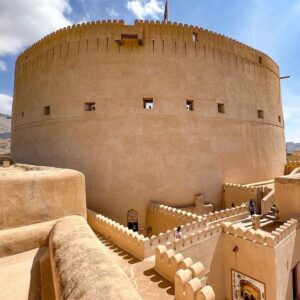
Nizwa was Oman’s ancient capital — the cultural, religious, and intellectual heart of the country for centuries. Its fort, built in the 17th century under Imam Sultan bin Saif Al Ya’rubi, took over twelve years to complete. The circular tower rises 34 metres, has a diameter of 45 metres, and once required enemies to pass through a series of traps before reaching the main hall. It remains one of the most visited heritage sites in Oman.
Come on a Friday morning and the experience doubles. The weekly cattle market outside the fort draws local farmers from across the interior — goats change hands, silver khanjars (daggers) are haggled over, and the atmosphere is entirely authentic.
Fact: Nizwa Fort received 143,767 visitors in 2019, making it Oman’s most visited fort.
5. Snorkel the Daymaniyat Islands Nature Reserve
Nine uninhabited islands sit in the Gulf of Oman about 18 kilometres from Muscat. The Daymaniyat Islands are a protected nature reserve — no development, no permanent human presence — and the coral reefs around them are among the healthiest in the Arabian Sea. Green sea turtles, reef sharks, rays, and dense schools of tropical fish are a regular part of a morning’s snorkelling here.
The crossing takes about 45 minutes by boat and the sea is calm between October and May. For experienced divers, the walls and bommies around the islands go deep and the visibility on a clear day is exceptional.
Best time: November to April for calm seas and best underwater visibility.
Fact: The Daymaniyat Islands are a protected nature reserve under Oman’s Ministry of Environment.
6. Visit Sultan Qaboos Grand Mosque at Dawn
Oman’s most recognisable landmark was completed in 2001 after six years of construction, using 300,000 tonnes of Indian sandstone. The main prayer hall houses what was, at the time of construction, the world’s second largest hand-woven carpet — a single piece measuring 70 by 60 metres, requiring four years and 600 weavers to complete.
The mosque opens to non-Muslim visitors in the mornings from Saturday to Thursday (closed Friday). Come early — by 9am the tour groups arrive. At 8am, with the light still low and the marble cool underfoot, it is one of the most serene places you will stand in the Middle East.
Visiting hours: Non-Muslims: 8:00–11:00am Saturday to Thursday. Dress code strictly observed — shoulders and knees covered, women require a headscarf.
Note: Visit the official mosque website for visiting guidelines
7. Walk the Muttrah Corniche and Souq
Muttrah is the old harbour district of Muscat — and it remains, despite everything, genuinely old. The Corniche runs along the waterfront past fishing boats, dhow repair yards, and the restored 16th-century Portuguese forts of Mirani and Jalali. The old fish market at the eastern end is worth five minutes even if you’re not buying — the daily catch is extraordinary in variety.
The Muttrah Souq is one of the oldest markets in the Gulf. It runs deeper and more warren-like than it looks from the entrance — silver jewellery, frankincense, Omani textiles, and hand-embroidered khuma caps. Unlike some Gulf souqs, this one still functions as a working market for locals.
Best time to visit: Early morning or late afternoon. Avoid midday heat in warmer months.
8. Abseil Through Snake Canyon
Snake Canyon — locally known as Wadi Bani Awf — is a series of narrow, twisting slots in the Western Hajar Mountains where the only way through is to swim, scramble, and abseil. The canyon walls close to a few metres wide in places, and the route requires multiple short abseils over waterfalls into deep pools.
This is not a gentle walk. It is a full day of technical adventure, and it is extraordinary for it. The canyon is carved through banded rock in shades of orange and grey, and the light that filters down into the narrow sections creates a quality that stays in your photographs for years.
Note: This tour requires reasonable fitness and comfort in water. All safety equipment is provided on guided tours.
9. Watch Green Sea Turtles at Ras Al Jinz
Every year, thousands of endangered green sea turtles return to the beach at Ras Al Jinz — on Oman’s easternmost point — to lay their eggs in the same sand where they themselves were hatched. It is one of the largest green turtle nesting sites in the Indian Ocean.
Guided night tours take small groups to the beach under red-filtered torch light to watch nesting females at work. Between July and September, the hatchlings emerge — hundreds of them at a time — and make the short journey to the sea. As wildlife experiences go, this is among the most affecting you will find anywhere.
Best time: May to October for nesting. July to September for hatching.
10. Drive the Musandam Fjords
Oman’s northernmost tip — the Musandam Peninsula — is a detached enclave surrounded by the UAE on land and the Strait of Hormuz by sea. Its coastline is a series of dramatic fjords — locally called khors — where brown limestone mountains plunge directly into dark blue water.
The traditional way to see it is by dhow — a half-day or full-day boat journey through the fjords with dolphins, the occasional jumping fish eagle, and the surreal experience of floating between vertical cliffs in complete silence. Khasab is the jumping-off town; most visitors fly or drive from Dubai or Muscat.
Best time: October to April. Summer is hot but the fjords are accessible year-round.
11. Explore Jebel Akhdar’s Rose Terraces
Jebel Akhdar — the Green Mountain — sits at around 2,000 metres in the Western Hajar range and is one of the few places in Arabia where roses, pomegranates, apricots, and walnuts grow. The ancient terraced farms, cut into the cliffside by hand over centuries and irrigated by the UNESCO-listed falaj system, produce the Damask rose used in Oman’s famous rose water.
The rose harvest happens in late March and early April — a narrow window when the hillsides are pink and the air carries a scent completely unexpected in a country most people associate with heat and dust. Outside of harvest season, the villages, viewpoints, and cool mountain air make it one of the most pleasant drives in Oman.
Note: Oman’s ancient falaj irrigation systems are a UNESCO World Heritage Site.
12. Attend a Performance at the Royal Opera House Muscat
It may seem unexpected — an opera house in the Gulf — but the Royal Opera House Muscat is one of the finest performing arts venues in the region and genuinely worth an evening. The building itself is an architectural achievement: a blend of Italian marble, Omani craftsmanship, and Arabian geometric design that manages to feel entirely coherent.
The programme runs from October to June, featuring international orchestras, ballet companies, opera, and traditional Omani cultural performances. Even if classical music isn’t your thing, the building alone justifies a walk around the complex at night when it is lit up.
Note: Check the current programme and book tickets at rohmuscat.org.om
13. Visit Bahla Fort and Jabreen Castle
Bahla Fort — a UNESCO World Heritage Site — is one of the largest forts in Oman, built by the Nabahina tribe between the 12th and 15th centuries. The mud-brick construction, towers, and long defensive walls stretch across a hillside above the oasis town of Bahla. It feels genuinely ancient in a way that many restored heritage sites do not.
Nearby Jabreen Castle, built in 1671, is the architectural counterpoint — not a defensive fortress but a palatial residence with painted wooden ceilings, private libraries, and rooms for the study of astrology. Together, they make one of the richest half-days in Omani heritage tourism.
UNESCO: Bahla Fort was listed as a UNESCO World Heritage Site in 1987.
14. Take a Sunset Dhow Cruise from Muscat
The traditional wooden dhow is to Oman what the gondola is to Venice — a vessel tied deeply into the country’s cultural identity. Oman was once one of the great maritime trading nations of the Indian Ocean, and the dhow was its instrument.
A sunset cruise out of Muscat Bay takes you past the Portuguese forts, out along the rocky coastline, and back as the mountains turn gold and the city lights come on behind the harbour. Dolphins appear regularly around the bow. It is, in the best possible way, a quiet and uncomplicated way to spend an evening.
15. Experience the Khareef Season in Salalah
Oman’s most surprising experience is one most international visitors never see. Between late June and early September, the Indian Ocean monsoon transforms the Dhofar mountains around Salalah from dry brown hills into a lush, misty, green landscape unlike anything else in the Arabian Peninsula.
Waterfalls appear on cliffs that were bare rock a month before. The temperature drops to around 22°C while Muscat bakes at 42°C. The Salalah Tourism Festival brings music, markets, and frankincense trade to the old souq. Over 827,000 visitors made the journey to Salalah for the Khareef in 2025 — mostly from within Oman and the GCC.
Best time: Late June to mid-September. Peak green in July and August.
Getting there: Oman Air operates direct flights from Muscat to Salalah.
Fact: 827,115 visitors travelled to Dhofar during the Khareef season in 2025.
Practical Information for Visitors
- Getting around A rental car gives you the most freedom for wadis and mountain routes. Many experiences — especially wadis — require a 4WD. Guide Compass tours include all transport.
- What to pack Swimwear for wadis, modest clothing for forts and mosques, solid shoes for any hiking, high-factor sunscreen year-round, minimum 2 litres of water per person for any outdoor activity.
- Language Arabic is the official language. English is widely spoken in Muscat and by all tourism professionals. Outside the capital, basic Arabic phrases are appreciated.
- Currency Omani Rial (OMR). 1 OMR ≈ 2.60 USD. Cash widely accepted. ATMs available in all towns.
- Visa Most Western passport holders can obtain a visa on arrival or e-visa. Check current requirements at rop.gov.om before travel.
Oman is most famous for its wadis — natural canyon rivers with turquoise pools — particularly Wadi Shab, which draws travellers from across the world. Beyond wadis, Oman is known for its well-preserved forts and castles, the dramatic scenery of Jebel Shams, the Wahiba Sands desert, dolphin watching, and the unique Khareef monsoon season in Salalah.
Five days is the minimum for a meaningful trip covering Muscat, one or two wadis, and a desert or mountain experience. Seven to ten days allows a well-rounded itinerary including Nizwa, Jebel Shams, Wahiba Sands, and a sea tour. Two weeks opens up Salalah, Musandam, and the Sur coastline.
Yes — Oman is one of the best adventure destinations in the Middle East. Wadi trekking, canyon abseiling, mountain hiking, desert camping, snorkelling, caving, and off-road driving are all readily available, well-organised, and relatively affordable compared to equivalent experiences in Europe or the Americas.
Oman is the only Gulf country with significant mountains, wadis, and diverse natural landscapes. It has not pursued the high-rise, luxury-resort model of its neighbours. The culture is notably traditional and authentic, the country is safe and clean, and the natural environment — from the Hajar Mountains to the Wahiba Sands to the Daymaniyat coral reefs — remains largely unspoilt.
Oman is consistently rated one of the safest countries in the world for solo travel, including solo female travel. The country ranks highly on the Global Peace Index. Public transport is limited outside Muscat, so joining a guided tour or renting a car is the practical way to reach wadis and mountain areas.
Wadi Shab, Jebel Shams, Wahiba Sands overnight camping, Nizwa Fort on a Friday morning, and a sunset dhow cruise from Muscat — these five experiences cover the essential range of what makes Oman extraordinary. If time allows, add the Daymaniyat Islands for snorkelling and Jabreen Castle for Omani heritage at its finest.
Yes! We offer special rates for families, groups, and repeat travelers. Just ask us for a custom quote based on your group size.